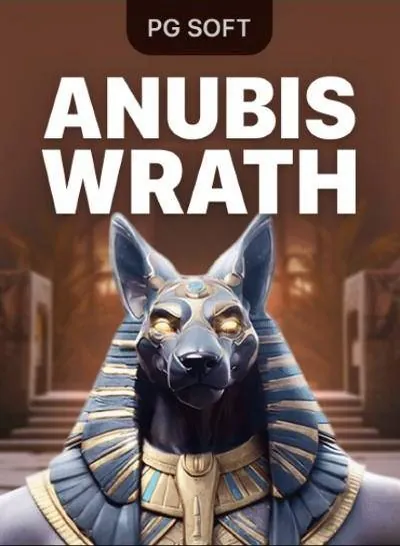

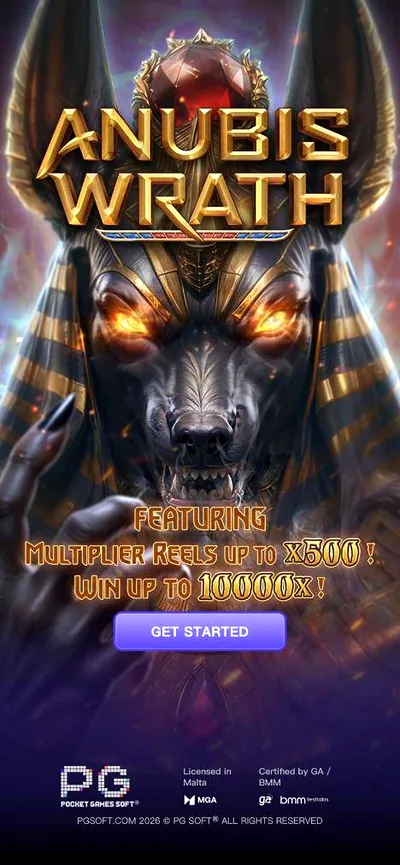
Deep in a labyrinth of ancient Egypt, Anubis sits in judgment. In PG Soft’s story, adventurers come to face the weighing of the heart: their heart on one side of the scale, the feather of Ma’at on the other. A heart lighter than the feather earns Anubis’s approval and the symbol of life. Anubis Wrath, released in May 2024, turns that judgment into a game about one moment: the instant the god appears and the multipliers come alive. This is one of the darker themes in the catalog, and it suits a game where everything waits on one figure arriving.
Five reels and a reel of sleeping multipliers
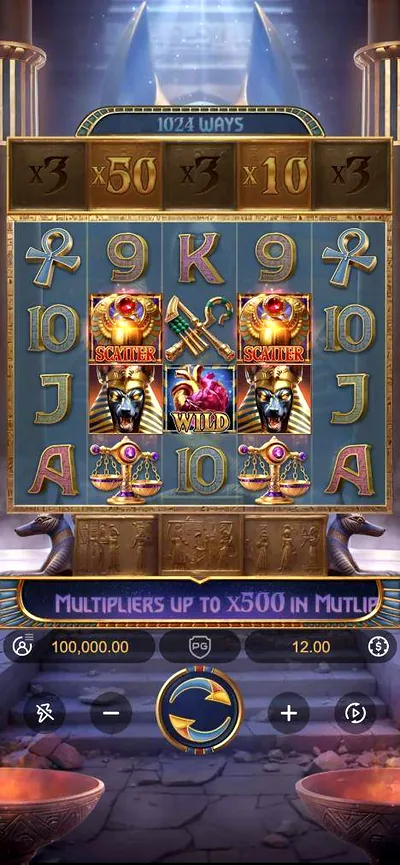
The grid is 5×4 with 1,024 ways to win. Every paying combination vanishes and the gaps refill from above, which lets one spin pay several times. It is a compact grid by the standards of the studio’s big cascade games, which keeps the screen easy to follow even when a chain runs long.
What sets it apart is a separate Multiplier Reel. Before each spin resolves it reveals a value between x3 and x500 for each of the five reels. Those values don’t apply automatically. A reel’s multiplier only switches on when an Anubis symbol lands on that reel, and it stays on until the spin ends. When the cascades finish, the spin’s winnings get the sum of every activated value applied, so two or three Anubis symbols on different reels add their multipliers together.
That design shapes the whole session. Most spins play out as a normal cascade slot. When Anubis does appear, the question becomes what the multiplier above that reel is holding at that moment, and the gap between a small multiplier and one in the hundreds is enormous.
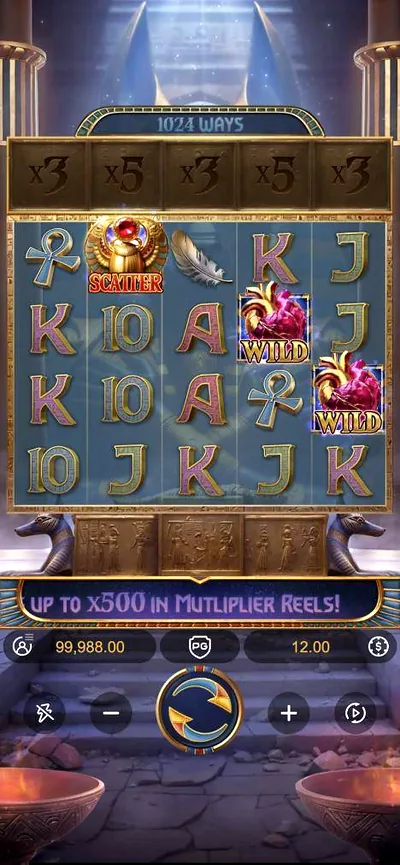
A running total below the reels
Three scatters trigger 15 free spins, a generous count from a modest number of scatters, and each extra scatter adds 3 more. Free spins can be retriggered. During the feature, every multiplier awarded joins a running total shown below the reels, and that total stays until the round ends. Each free spin with an activated multiplier pays out at that spin’s activated values plus the running total, which is where the game’s biggest results are most likely.
x3 to x500 per reel, 10,000x in total
The studio’s best RTP version is 96.75%, with high volatility. PG Soft attributes 70.86% to regular spins and 25.89% to free spins. About 30 percent of spins pay something, and the feature lands on roughly 0.40% of them. The top win is 10,000x the bet. That is typical for the studio’s newer high-risk games and well below the 100,000x of the older cascade titles. In play the volatility is obvious: long stretches pass without Anubis, and the results arrive in sudden jumps rather than a steady climb.
Anubis pays 2.5x, the reel does the rest
Without a multiplier the symbols pay very little. Five Anubis symbols on one way return 2.5x the total bet, Scales and the Crook and flail give 2x, and the Ankh and Feather stop at 1x. The bottom of the table is thinner still: three 9s or 10s pay 0.05x, a single cent at the default minimum stake of €0.20, and even five Js or Qs reach only 0.25x.
Set that against the sheet. Spread over the 29.58% of base-game spins that pay, the base game's share of the return works out at about 2.4x the bet per winning spin, far above what most of the table can deliver on its own. The difference is carried by stacked ways, cascades and, above all, by Anubis landing under a high value on the multiplier reel. The default stake runs from €0.20 to €100, and there is a Feature Buy for anyone who would rather not wait around 250 spins for three scatters.
How it differs from other multiplier games
Most PG Soft multipliers grow with each cascade, so a long chain is the route to a big win. Here the multiplier is decided separately and then switched on, which makes the outcome less about chain length and more about timing. If you enjoy the slow build of Wild Bandito, this will feel different: less gradual, more all or nothing.
How long a wait for Anubis can be
The game sheet gives free spins a 0.40% hit rate, so the round arrives about once in 250 spins. Over 500 demo spins that means two features as the typical result, with a 13% chance of none; in 300 spins, the chance of none rises to about 30%. The base game pays often, close to 150 times in 500 spins, and the longest run without a win is usually only about 14. What makes the game feel harsh is the distance between those small wins and the big ones. A win of 20x or more lands about once in 143 spins, and a 500-spin session has roughly even odds of a win above 50x. Most of that comes down to whether Anubis lands under a high multiplier.
Count how often Anubis lands and note the multiplier each time. That gives you a feel for the spread. With high volatility, a few hundred spins is the minimum sample before drawing any conclusion.
Random means random
Because everything hinges on Anubis, it is tempting to look for patterns: a feeling that he is due after a long absence, or that a certain stake brings him more often. Neither holds. Each spin is settled independently by the game server, the symbol has no memory of previous spins, and the stake only changes the size of a win, never how often the god appears. The same goes for turbo and autoplay, which only speed up the animation. The only honest way to judge the game is a long run in demo mode with a fixed stake.
Who will wait for the jackal god
Anubis Wrath is for players who enjoy high volatility and a single, clear trigger to wait for. More games from ancient Egypt are in the Egypt collection, and other swingy titles in the high volatility collection.



 Nothing found