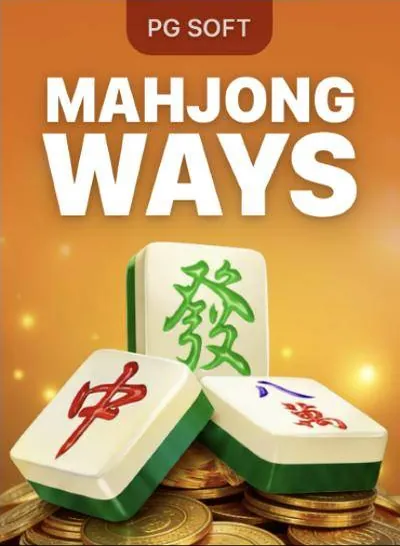


In January 2020 PG Soft released its very first mahjong-inspired slot, and it set off a trend the studio is still riding. The sequel came three months later and grew bigger in every respect, but the original remains the clearest way to understand how this family of games works: one ladder, one kind of gold tile, one free spins rule.
Five reels, four rows of tiles
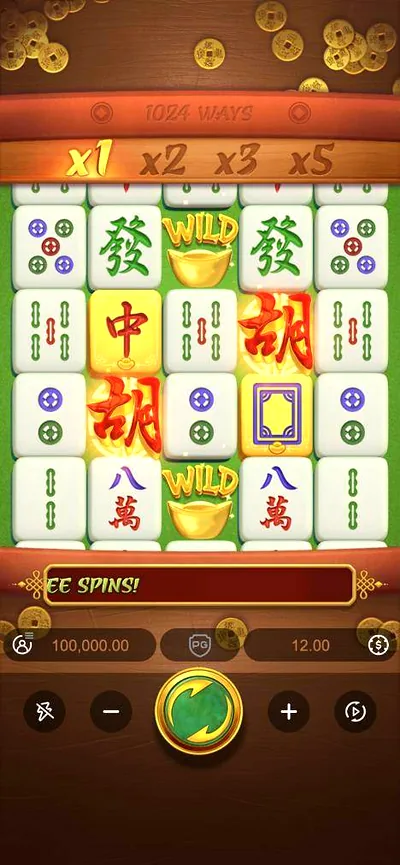
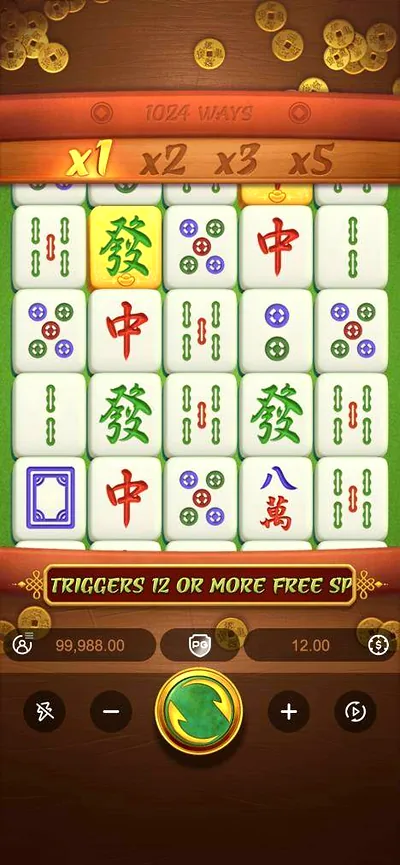
The board has five reels of four rows, with 1,024 fixed ways to win. Matching tiles on adjacent reels from the left form a win, the winning tiles clear, the ones above slide down and new tiles drop in. Then the game checks again. Wilds stand in for everything except the scatter, and all payouts are quoted against the total bet.
The symbols are mahjong tiles: characters, bamboo and circles, alongside wilds, gold tiles and the scatter. You don’t need to know how to play mahjong; the slot only borrows the imagery of the tiles. Newcomers sometimes find the tiles hard to tell apart at first, and that passes within a few spins of watching the wins form.

The ladder
Above the reels sits a ladder of four values: x1, x2, x3 and x5. Every spin starts at x1, and each winning cascade moves it up one step. The fourth cascade and every one after it are paid at x5. When the spin ends, the ladder drops back to x1.
The fixed ladder makes the game easy to read. You always know what the next link is worth, and you know that a chain of four or more links is where the base game gets interesting.
It also limits the base game in a way an open-ended counter doesn’t. A ten-link chain pays its last seven links at x5, no more. Compared with a game like Wild Bandito, where each extra link adds one more step with no upper limit, the mahjong ladder trades long-chain upside for predictability, and that trade is a big part of why the game feels steady.
Gold tiles
Gold-plated tiles land on reels 2, 3 and 4. When one is part of a win, it stays on the grid as a wild for the next cascade instead of disappearing. That wild sits in the middle of the grid, where it can connect the most ways, and it is often what turns a two-link chain into a five-link one.
Twelve spins on a doubled ladder
Three scatters anywhere on the grid trigger 12 free spins, with two more for every additional scatter, and more scatters inside it extend the round. During free spins the ladder is doubled: x2, x4, x6 and x10. So even the first win of every free spin pays double, and a chain of four links or more is paid at x10.
That is where the game’s potential sits. The base game tops out at x5; the feature tops out at x10, and twelve spins give it several chances to build long chains.
Three tiles or five
Most of the value in this table sits on reels 4 and 5. Three Green Dragons pay 0.75x the total bet, four pay 3x and five pay 5x, so stretching a win from three reels to five multiplies it by more than six. The lower tiles follow the same curve: three Two of Dots or Two of Bamboo return 0.1x and five return 0.5x. At the €0.20 minimum stake the smallest win is two cents.
The curve combines with the ladder. A five-reel Green Dragon win on a single way, landing on the fourth cascade of a free spin at x10, comes to 50x the bet before any other ways are counted; the same win at the base game's x5 pays 25x. Three-reel wins turn up far more often than five-reel ones, which is why most base results stay small, and why gold wilds on the middle reels are so useful for carrying a win to the end of the grid. The stake goes up to €50, and there is no Feature Buy.
25,000x, a quarter of the sequel
The highest published RTP is 96.92%, one of the higher figures in its catalog, and the studio’s volatility rating is medium. The top win is 25,000x the bet. That is a quarter of the sequel’s 100,000x, and the difference comes almost entirely from the sequel’s gold third reel in free spins. The feature lands on 0.49% of spins and holds 28.03% of the return. Across a billion test spins the studio’s best single result was 2,893x, which shows how far the advertised figure sits from everyday play.
The original in numbers
The sheet puts free spins at a 0.49% hit rate, about one in 204 spins. That works out to between two and three features in a 500-spin demo, with a 9% chance of none. Roughly 143 spins pay, and the longest gap without a win is usually around 15. Wins of 20x or more come about once in 187 spins, slightly more often than in Mahjong Ways 2, while wins over 50x appear about once in 1,222, so two sessions in three end without one. The two games are closer in session rhythm than their very different ceilings suggest; the gap shows up mainly in how far a single free spins round can run.
Count how often a chain gets past three links in the base game, since that is when the ladder reaches x5. Then wait for free spins and compare how many long chains you get there. A long session on one stake gives a fair picture. More games built on the same principles are in the cascade slots collection.
Original or sequel
Mahjong Ways 2 has a taller middle, 2,000 ways and a feature where every regular tile on reel 3 turns gold. It also starts free spins with 10 rather than 12. If you want the bigger top win, the sequel is the one. If you want to learn the system first, the original is easier to follow, and the free spins ladder is exactly the same. Both games are compared side by side in Mahjong Ways vs Mahjong Ways 2.
Mahjong Ways is the right starting point for anyone curious about PG Soft cascades. It is calm, readable and still capable of a large feature. Once it clicks, move on to the sequel; if it doesn’t, the Fortune series offers a completely different, simpler style.







 Nothing found